
Criminal Cases in Vernon Parish Courts
The Thirtieth Judicial District Court, or 30th JDC, hears Vernon Parish felony prosecutions and other district criminal matters. Its three judicial divisions operate from the parish courthouse. The Vernon Parish Clerk of Court keeps the filed case record: the case number, charging instrument, minute entries, motions, hearing settings, judgment, and sentence. The prosecutor may begin a felony case with a bill of information, a written accusation filed by the district attorney, or with a grand-jury indictment. Those filed charges may differ from the allegations shown at jail intake.
Lower-level records do not all flow to the district clerk. Leesville City Court maintains its authorized traffic and criminal docket, and its official page directs those inquiries to Leesville Police. New Llano has a statutory mayor's court for municipal matters. A citation, bond paper, or charging notice should identify the court. Use that label before calling, because a Vernon Parish district search will not necessarily reveal a city or mayor's court file.
Call Vernon Parish Criminal Clerks
The Clerk's directory routes criminal and minute questions to 337-238-4824, option 2. Have the full name, approximate filing year, and case or citation number ready. Ask whether the file is public, whether staff can identify it by phone, and whether inspection at the counter is required. The office has not published a criminal-copy fee schedule, so request the current price for plain and certified copies before ordering.
The public counter is at 215 South Fourth Street, Leesville, Louisiana 71446. Mail goes to P.O. Box 40, Leesville, LA 71496-0040. Hours are weekdays from 8:00 a.m. to 4:30 p.m., except statutory holidays. The courthouse bars cell phones, purses, and backpacks, and no locker service is promised. Plan to leave those items secured.
Tell staff what document will answer the question. A docket or minute sheet gives a compact event history. The charging paper identifies the accusation the prosecutor actually filed. A judgment and sentencing instrument show the result and terms. When proof must be sent to BCII to repair a missing disposition, ask for a certified copy rather than a plain photocopy. Certification means the Clerk authenticates the record as an official court copy.
The official criminal and minute clerk directory shows the right phone route:
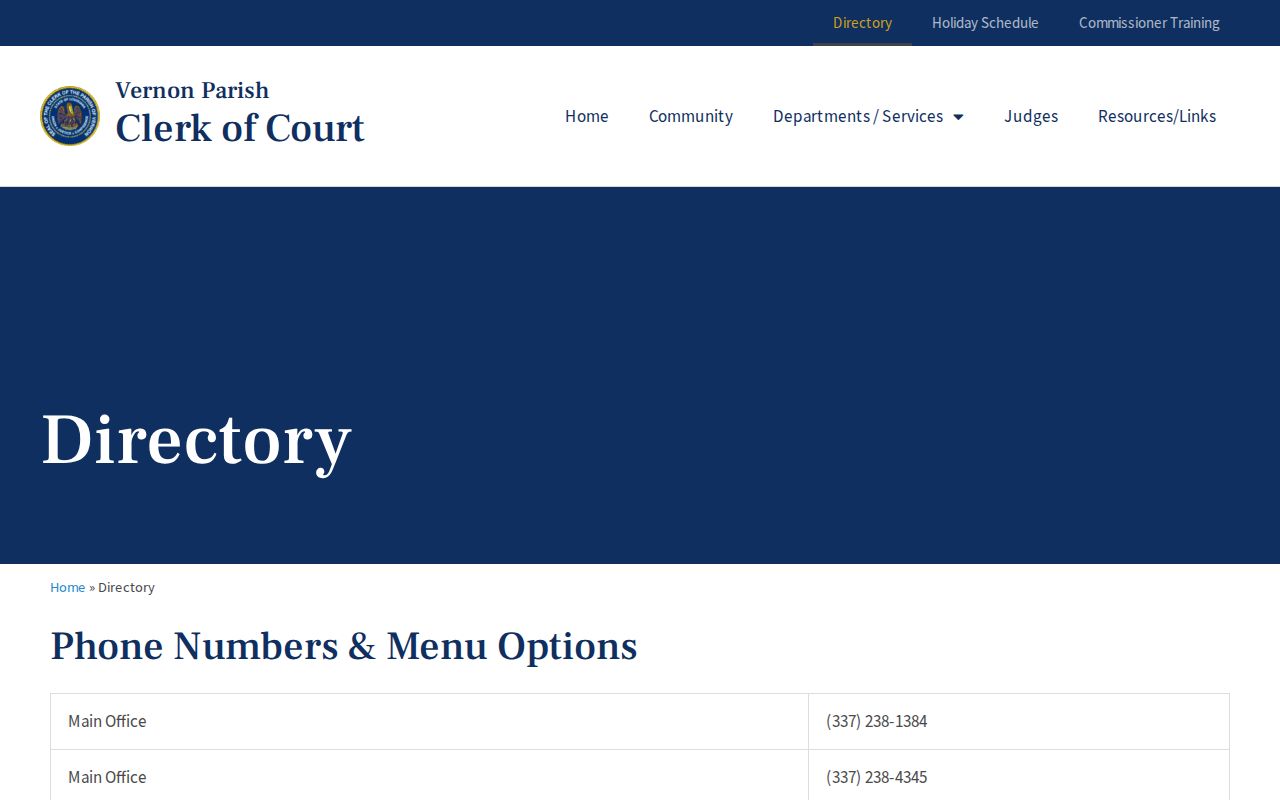
That direct route matters because land, marriage, civil, and criminal records are handled through different services.
How to Search Vernon Parish Case Records
No comprehensive free statewide trial-court criminal search covers Vernon Parish, and the parish's public eSearch does not include criminal dockets. The dependable route is to identify the correct court, contact its clerk, and request the docket or minute sheet. A minute sheet is the dated court chronology; it can reveal arraignment, settings, rulings, disposition, and sentence without requiring every pleading in the file.
- Read the citation or charging paper and decide whether it names the 30th JDC, Leesville City Court, or a mayor's court.
- Call the correct clerk with the person's full name, approximate date, arresting agency, and case or citation number.
- Use date of birth only when the custodian lawfully requests it to separate similar names.
- Ask for the docket or minute sheet, then identify the filed charge, current status, and final disposition.
- Request a plain copy for reference or a certified disposition when another agency requires proof of the outcome.
| Field Label | Type | Required | Notes |
|---|---|---|---|
| Full name | Text | Practical | Give legal name and known spelling variants. |
| Case or citation number | Text | No | The fastest and most exact identifier. |
| Approximate date | Date/year | No | Helps staff narrow older or archived files. |
| Date of birth | Date | Only if requested | Use to distinguish similar names. |
| Court or agency | Text | No | Separates district, city, and mayor's court matters. |
Vernon eSearch Excludes Criminal Cases
A common dead end is the Vernon Clerk public eSearch. Its landing notice describes mortgage and conveyance services plus marriage indexes. It does not advertise Vernon Parish criminal court cases. An account sign-in on that screen does not turn the land-record index into a felony docket search.
The portal's own scope notice provides the clearest warning:
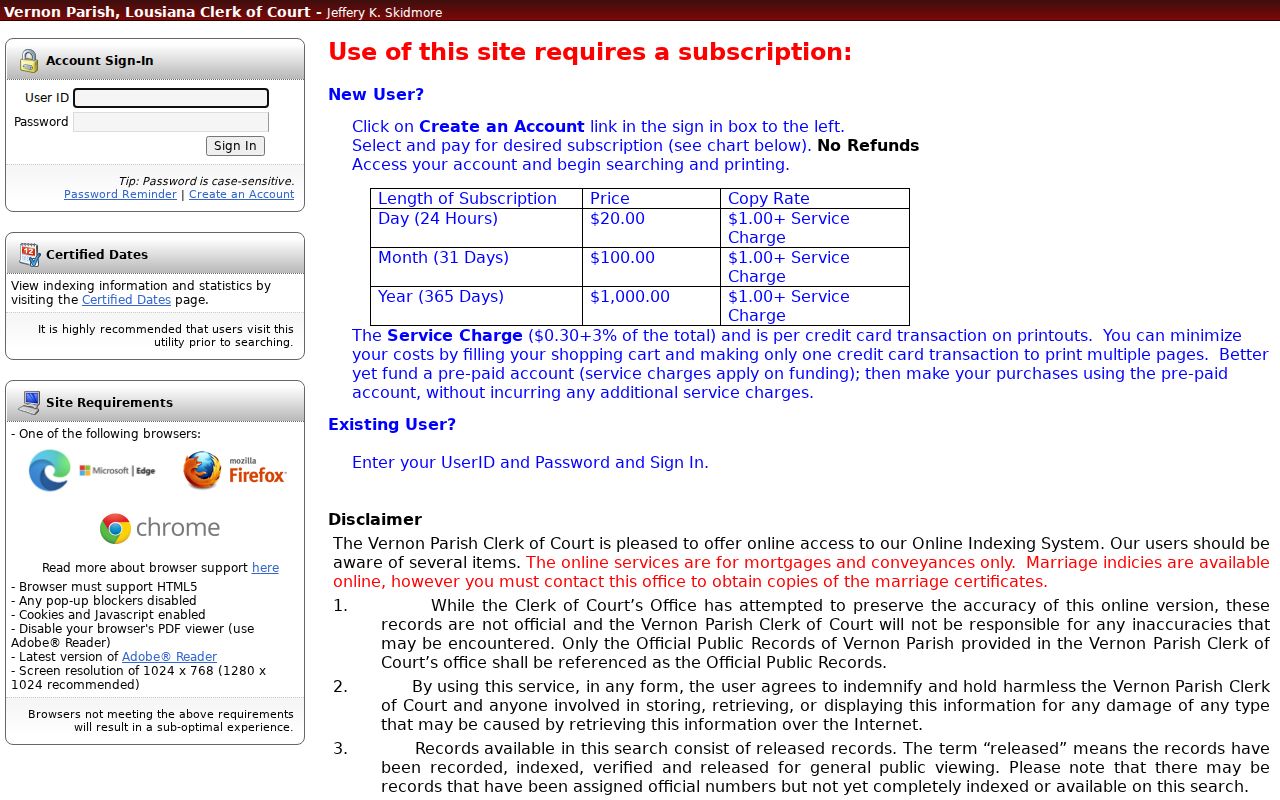
When a criminal case is missing online, call the criminal and minute clerks instead of concluding that no case exists.
This distinction also prevents false matches. A land-record result may share a person's name yet have no relation to a prosecution. Conversely, a valid criminal file may exist only at the clerk counter or in an archive. Louisiana services such as Clerk Connect and eClerks LA depend on participating clerks and locally chosen coverage; neither creates a guaranteed statewide Vernon criminal index.
What Vernon Parish Case Files Show
A court file is organized around the filed prosecution rather than jail intake. Start with the case number and charging document, then trace the minute chronology. The disposition tells how each charge ended. A judgment records the court's formal ruling, while the sentencing instrument states confinement, probation, fines, costs, and other conditions. Protected identifiers may be redacted from a public copy.
| Case Number & Court | Identifies the docket, division, and court of record. |
|---|---|
| Charging Document | Shows the bill of information, indictment, complaint, and cited offenses. |
| Docket Entries | Lists filings, appearances, motions, rulings, and minute activity. |
| Hearing Dates | Tracks arraignment, motion, trial, and sentencing settings. |
| Disposition & Judgment | Records dismissal, nolle prosequi, plea, acquittal, or conviction. |
| Sentence & Conditions | States custody, probation, fines, costs, and court-ordered terms. |
Read Vernon Parish Minute Entries
A minute entry is a short official record of what occurred in court on a set date. “Arraignment” means the accused was told the charge and entered a plea. “Nolle prosequi” means the prosecutor formally stopped pursuing a charge; it is not the same event as an acquittal after trial. “Pending” describes an unresolved matter and is not a finding of guilt.
- Information
- A formal accusation filed by the prosecutor.
- Indictment
- A felony accusation returned by a grand jury.
- Disposition
- The current or final outcome assigned to a charge.
- Certified disposition
- A clerk-authenticated record used to prove the result to BCII or another official recipient.
Read the charge line and the outcome together. One case can contain several counts, and each count may end differently.
A plea is the defendant's formal response to a charge. A guilty plea may resolve one count while the state dismisses another. An acquittal is a not-guilty determination, while a dismissal ends a charge without that trial result. “Concurrent” sentences run at the same time; “consecutive” sentences run one after another. These terms can materially change the meaning of a short Vernon Parish minute entry.
Stages of a Vernon Parish Criminal Case
After an arrest or citation, a judicial officer reviews probable cause and release. The district attorney then screens the allegations and decides what to file. A felony may proceed by information or indictment. Arraignment follows, then discovery and motions, a plea or trial, judgment, and sentence. An appeal from the 30th JDC goes to the Third Circuit and may later reach the Louisiana Supreme Court. No fixed local time applies to every stage.
Case flow: Charges Filed › Arraignment › Pretrial › Plea or Trial › Disposition › Sentencing
Older Vernon Parish Criminal Files
Most Vernon Clerk records begin in 1871, when the parish was created. An older criminal file may need archive retrieval and may not be indexed for remote access. Give the clerk a broad but useful date range, spelling variants, and any known case number. Ask whether the docket, minutes, or final judgment can be copied without pulling every paper in the file.
The Clerk departments page identifies the counter services available:
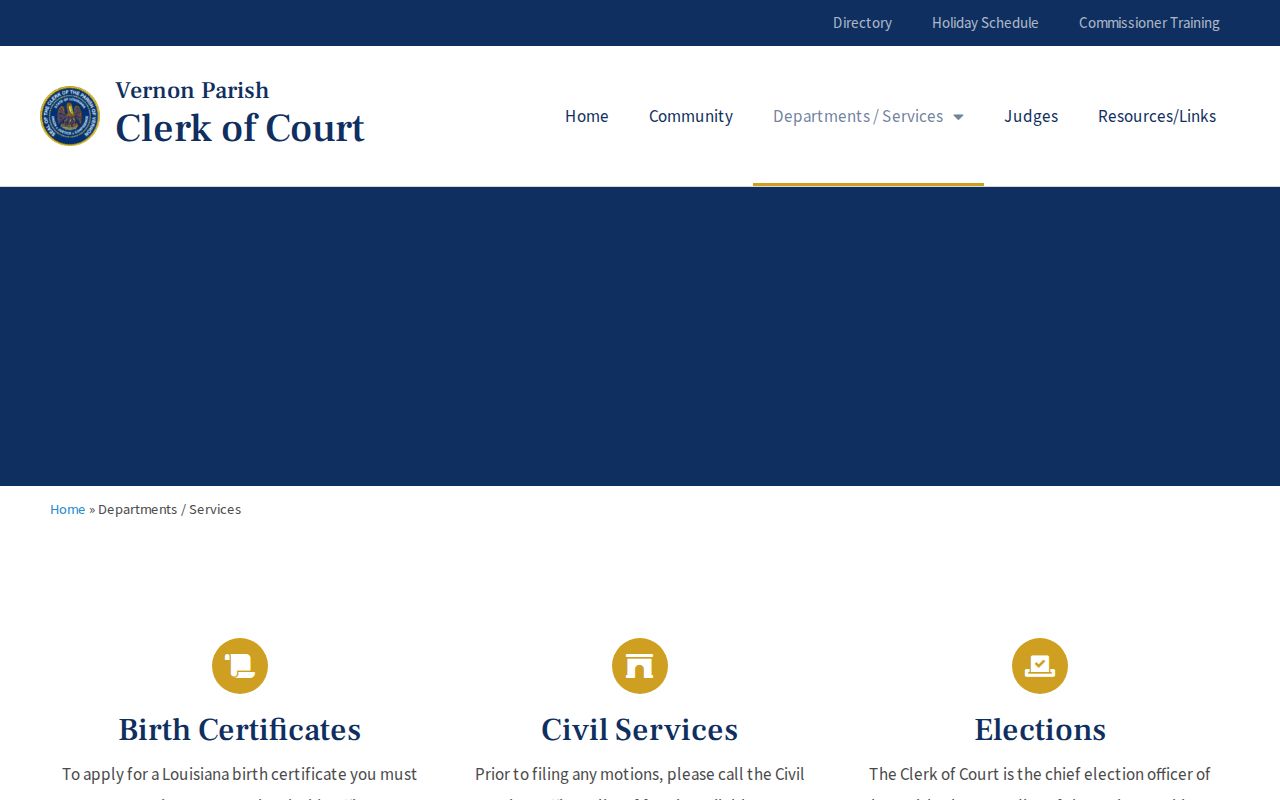
For genealogy or historical research, a year and name may be more useful than a modern online search that does not cover criminal files.
District 30 Defense Records
The District 30 public defender listing confirms the indigent-defense office serving Vernon Parish, though the state page currently labels its headquarters in Beauregard Parish. Call before traveling. Defense files are confidential and are not substitutes for the public clerk docket.
The official listing offers useful jurisdiction context:
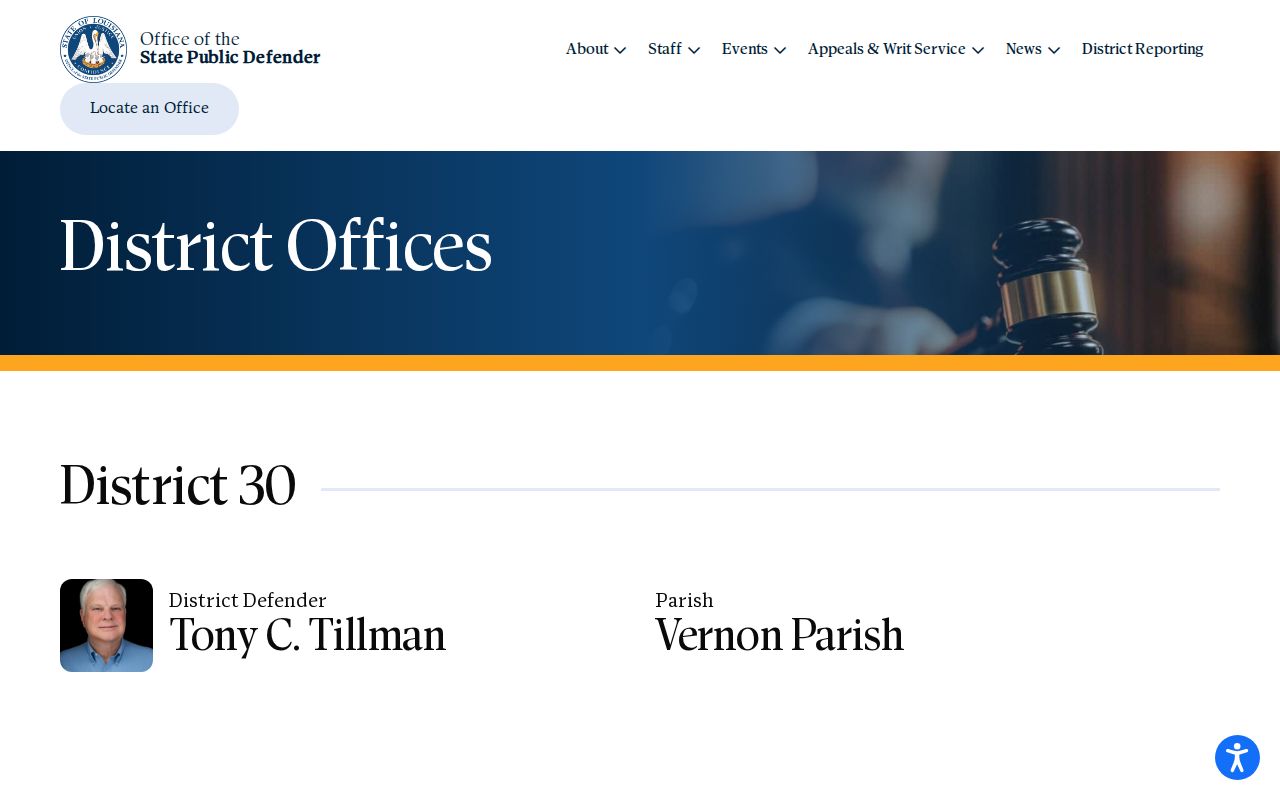
Public case status and certified outcomes still come from the court clerk, not the district attorney or defense counsel.
Vernon Parish Case Access Restrictions
Louisiana court records are generally available through the responsible clerk, but access is not absolute. Juvenile cases follow separate restrictions. Social Security numbers, protected victim or minor details, medical material, and sensitive investigative facts may be sealed or redacted. An expunged record is removed from public access but not destroyed; law-enforcement and other authorized agencies may retain access under Louisiana law.
When a Vernon Parish case does not appear, ask the clerk whether it belongs to another court, awaits archive retrieval, is sealed, or requires in-person review. A public-records request is useful for agency administrative material, but a direct clerk-record request is the proper route for judicial pleadings, minutes, and certified judgments. Request the legal basis in writing if access is denied.
Do not treat a sheriff report as the court outcome. The arresting office controls its narrative, the district attorney controls prosecution work product, and defense counsel controls confidential defense material. Each custodian may hold papers that never become part of the public docket. For a reliable case result, match the defendant, case number, and individual count to the Clerk's final disposition and sentence.